

Cold weather and winter explained simply

In the Northern Hemisphere, Earth reaches its closest point to the Sun in early January. Yet in Canada, this coincides with one of the coldest periods of the year. This may seem contradictory, but the distance between Earth and the Sun is not actually the determining factor.
So why it is cold in winter when Earth is closer to the Sun? The answer lies in the tilt of Earth’s axis, which affects the angle at which the Sun’s rays strike Earth and the length of daylight hours.
Earth’s tilt and the changing seasons
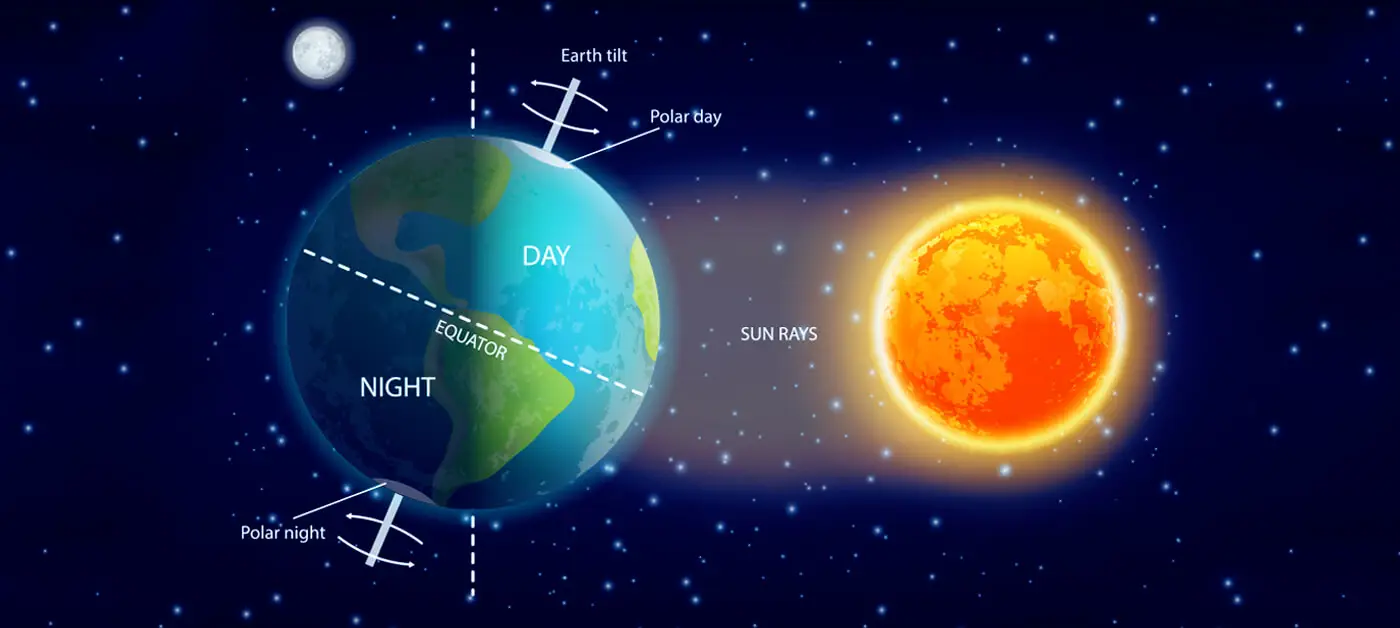
Earth’s axis is not perfectly upright but tilted at an angle of 23.5 degrees. This tilt remains constant as our planet orbits the Sun, which results in the changing seasons.
In winter, the Sun appears lower in the sky, and its rays strike Earth at a shallower angle. The same amount of solar energy is spread over a larger area, reducing the amount of heat received by any given location.
To illustrate the effects of Earth’s axial tilt, we can compare the Sun’s rays to the beam of a flashlight. When the beam is directed straight at a surface, the light is concentrated and intense. As soon as the flashlight is tilted, the same light spreads over a larger area and becomes less concentrated. As a result, it appears less intense at any given point.
In winter, the Northern Hemisphere, which includes Canada, Europe and most of Asia, is tilted away from the Sun. The Sun’s rays strike us less directly, so we receive less solar energy during the day. The ground, air and water absorb less heat, temperatures drop and precipitation is more likely to fall as snow.
During the same period, the opposite occurs in the Southern Hemisphere, which is tilted toward the Sun. The Sun’s rays are more direct, and the days are longer. These conditions bring warmer, summer-like temperatures. So, when it’s time to bundle up in toques and mittens in Canada, summer is settling in across Southern Hemisphere countries such as Australia, South Africa and Argentina.
Good to know: The word austral comes from the Latin auster and describes things associated with the Southern Hemisphere. In ancient Rome, auster referred to a warm wind from the south. In geography and astronomy, austral is the opposite of boreal, which comes from Boreas (the north wind), and describes things associated with the north… such as our northern lights!
Shorter days, less heat
The angle of the Sun’s rays isn’t the only factor behind falling temperatures. The longer distance sunlight travels through the atmosphere also reduces its intensity. Finally, around the winter solstice in December, when it gets dark by 4 p.m., the duration of daylight also plays a significant role.
During the cold season, days are much shorter. This means fewer hours of sunlight to warm the ground during the day and more time at night for the accumulated heat to gradually escape. The limited energy from a Sun low on the horizon is insufficient to offset the cooling that sets in night after night.
Does the distance between Earth and the Sun affect temperatures?
The answer is yes, but its influence is much less significant than Earth’s axial tilt, which is responsible for the seasons.
Earth’s orbit around the Sun isn’t a perfect circle but an ellipse. As a result, our planet reaches its closest point to the Sun in early January and its farthest point in early July each year. However, this variation in distance is too small to outweigh the effect of Earth’s tilt, which affects both the intensity of sunlight and the length of daylight hours.
The proof? When it’s winter in Canada and summer in the Southern Hemisphere, the entire planet is at the same distance from the Sun. If the distance between Earth and the Sun determined the seasons, the whole world would experience summer and winter at the same time!

Why are January and February temperatures so cold?
As mentioned earlier, Earth is closest to the Sun at the beginning of the year. Although you might expect temperatures to rise after the winter solstice, January is generally the coldest month in Canada. February often brings similarly cold temperatures and can even be colder in some regions. It usually takes until March for milder weather to arrive.
This is simply because the ground, water and air take time to warm up and cool down. Even though the days gradually get longer after the winter solstice, the Sun is still low in the sky, and Earth continues to lose more heat than it can absorb over the course of a day.
Winter: it’s all about Earth’s tilt
While various factors influence temperatures during the cold season — including climate change! — Earth’s tilt is the main reason we feel the chill this time of year. On a clear day this winter, observe the Sun’s position in the sky at noon, and you’ll notice that it stays low on the horizon, lower than it does at the same time in summer. That’s proof that winter is, above all, a matter of tilt!